Terrorist infrastructure based in Pakistan aims to destabilize South Asia, and its potential spillover into the Indo-Pacific and beyond underscores the urgency for ASEAN to forge a meaningful counterterrorism partnership with India.
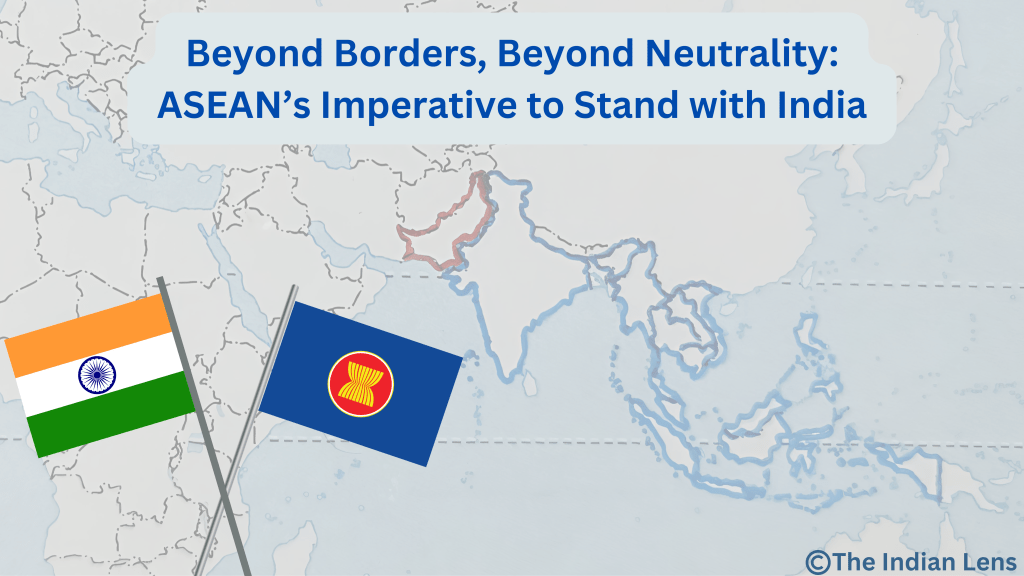
Ideally, a state facing economic collapse, political volatility, and deep societal fissures would prioritize internal reform and national stability. Yet, Islamabad continues to defy this logic. Instead of turning inward, it has persistently directed its strategic energies toward external disruption—undermining regional peace and prosperity across South Asia and, increasingly, beyond. State-sponsored terrorism emanating from Pakistan is now inching beyond bilateral hostility with India, evolving into a broader security challenge that risks long-term development frameworks such as ASEAN’s Community Vision 2045, India’s Viksit Bharat@2047, and similar growth-oriented strategies pursued by regional actors.
Pakistan-Sponsored Terrorism: A Regional Threat
Cross-border terrorism rooted in Pakistani soil is no longer India’s problem alone. It is fast evolving into a transnational, networked threat—precisely the kind ASEAN can no longer afford to overlook.
The 2008 Mumbai attacks, enabled by Pakistan-based UN-designated terrorist group Lashkar-e-Taiba’s maritime infiltration, revealed how sea routes could be weaponized by Pakistan-based groups. For ASEAN, with strategic chokepoints like the Strait of Malacca and the South China Sea serving as lifelines of trade and energy, this precedent raises urgent regional alarms.
Ideological spillovers are equally concerning. Extremist networks like Jemaah Islamiyah and Abu Sayyaf—historically active in Indonesia and the Philippines—have been linked to transnational outfits such as ISIS. Multiple arrests in Malaysia and Indonesia have traced digital radicalization back to handlers operating from Pakistan.
As highlighted by FATF and UNCCT reports, entities like Jaish-e-Mohammed (JeM) have used encrypted platforms to disseminate extremist content, sometimes even translating it into regional languages like Bahasa to expand their reach.
The threat also extends to civilizational diplomacy. Shared heritage circuits—Bodh Gaya, Kushinagar, and Buddhist pilgrimage routes—form the backbone of India–ASEAN soft power. The 2013 Bodh Gaya bombings were a grim reminder of the vulnerability of these sacred spaces. Another such attack could undermine not only cultural ties but also regional tourism and economic recovery.
In sum, Pakistan-sponsored terrorism constitutes a cross-regional threat architecture—one that exploits digital ecosystems, porous borders, and ideological fissures. ASEAN has shown it can act when its credibility is at stake, as it did in the Myanmar crisis. The question is no longer why ASEAN should respond—but whether it can afford not to.
Why ASEAN Must Partner with India
As terrorism increasingly transcends borders—ideologically, digitally, and operationally—the ASEAN region faces a strategic dilemma: whether to remain a neutral observer or to become an active stakeholder in regional counterterrorism cooperation.
India, with its extensive counterterrorism infrastructure, strategic geography, and normative alignment with ASEAN values, presents itself as a natural and credible partner. For decades, India has invested in developing capabilities across the counterterrorism spectrum—from intelligence and surveillance to cyber operations and hostage rescue. Unlike other major powers, India’s cooperation comes without political strings, military bases, or coercive diplomacy. Its partnerships are rooted in mutual respect, regional balance, and shared security interests. ASEAN’s growing vulnerabilities—ranging from digital radicalization to maritime smuggling routes being exploited by extremist networks—align closely with India’s existing threat landscape. A strategic partnership would not only address operational risks but also reinforce ASEAN’s own credibility as a peace-centric regional bloc under Vision 2045.
By remaining silent on Pakistan’s state-sponsored terror apparatus, ASEAN risks being perceived as selectively normative—willing to act on human rights in Myanmar or South China Sea militarization, but hesitant to confront state-sponsored violence in South Asia. A public alignment with India on terrorism, even if calibrated, would signal ASEAN’s shift from passive consensus to principled regional leadership.
What Should India and ASEAN Do Together?
To move beyond symbolic alignment, India and ASEAN must institutionalize their counterterrorism cooperation across operational, legal, and narrative domains. A fragmented, ad hoc response will not suffice in an era where terror networks exploit encrypted apps, dark finance routes, and ideological discontent as readily as weapons and safe havens.
To begin with, ASEAN should issue a joint statement condemning cross-border terrorism in the region. This would mark a vital normative departure and offer a foundational step for future coordination.
ASEAN should then collaborate with India on a real-time maritime surveillance framework modeled on India’s Information Fusion Centre – Indian Ocean Region (IFC-IOR), integrated with Southeast Asian coastal radar and port data. This system would track suspect vessels used for infiltration, arms smuggling, or terror logistics across the Bay of Bengal, Andaman Sea, and South China Sea—safeguarding critical chokepoints like the Strait of Malacca and Sunda Strait.
Additionally, an India–ASEAN joint task force on counter-terror finance should be established to detect and disrupt illicit money flows through hawala networks, crypto laundering, and shell companies. This would allow financial intelligence units across ASEAN to benefit from Indian technical support and FATF-aligned best practices.
On the ideological front, ASEAN and India should co-develop a Digital Narrative Hub to counter extremist propaganda in local languages—Bahasa, Tamil, Tagalog and more—leveraging indigenous storytelling, community influencers, and interfaith peace campaigns.
Finally, a legal convergence initiative must be launched to harmonize definitions of terrorism, enable cross-border evidence sharing, and establish fast-track extradition frameworks. This will prevent safe havens for fugitives and bolster regional legal interoperability.
The Costs of Inaction: What ASEAN Risks by Staying Silent
ASEAN’s strategic restraint has long been viewed as a diplomatic strength—anchored in its principles of non-interference and consensus. Yet, in the context of state-sponsored terrorism, silence is no longer neutrality. It risks becoming complicity by omission.
Pakistan’s cross-border terrorism, while directly targeting India today, carries the potential to destabilize Southeast Asia tomorrow. A continued lack of engagement on this issue not only threatens regional security but also erodes the normative foundation ASEAN claims to uphold.
First, ASEAN’s credibility as a principled regional bloc is at stake. The organization has shown it can take decisive stances—on the Myanmar military coup, the Rohingya crisis, and even on humanitarian and climate issues. Its silence on Pakistan’s proxy terror operations, however, exposes a dangerous double standard.
Second, there is the real possibility of terror network spillover. Multiple arrests across Malaysia, Indonesia, and the Philippines have revealed affiliations with handlers based in Pakistan or Afghanistan. These pipelines—ranging from encrypted digital channels to illicit maritime trafficking—could soon fuel recruitment or radicalization inside ASEAN.
Third, terrorism undermines India–ASEAN economic ambitions. Major infrastructure projects like the India–Myanmar–Thailand Trilateral Highway and Kaladan Multimodal Transit hinge on investor confidence. Instability—even indirect—will slow progress and divert attention from regional growth.
Fourth, shared spiritual sites remain vulnerable. A coordinated attack on sacred Buddhist spaces like the one that happened in Bodh Gaya in 2013 could disrupt religious tourism, damage cultural diplomacy, and harm ASEAN’s post-pandemic recovery.
Finally, strategic inaction creates a vacuum. Other powers may step in to offer security partnerships—potentially undermining ASEAN centrality and long-term autonomy.
In short, the costs of inaction are structural. ASEAN must recognize that peace is not preserved by passivity, but by principle-driven cooperation. The longer it defers engagement with India on terrorism, the greater the regional price.
From Strategic Silence to Strategic Responsibility
The threat of Pakistan-sponsored cross-border terrorism is no longer constrained to South Asia—it is evolving into a cross-regional challenge with implications for ASEAN’s maritime security, digital ecosystems, trade corridors, and shared spiritual heritage. In such a landscape, silence is not a shield. It is a strategic risk.
India and ASEAN are bound not just by geography, but by shared developmental aspirations—embodied in frameworks like Viksit Bharat@2047 and the ASEAN Community Vision 2045. These blueprints represent generational commitments to prosperity, peace, and progress. Terrorism, if left unchecked, threatens to derail them both.
This moment presents an opportunity to revive and operationalize the ASEAN Convention on Counter Terrorism (ACCT), which provides a legal framework for cooperation but remains underutilized. By aligning the ACCT’s provisions with India’s operational strengths, both sides can co-develop joint protocols on tracking terror financing, radicalization, and cross-border intelligence.
By stepping forward, ASEAN will not be choosing sides—it will be choosing stability. A forward-looking partnership with India in counterterrorism – building upon ASEAN–India Delhi Declaration of 2018 – is not about confrontation, but preservation. The time for normative ambiguity has passed. ASEAN has the institutions, values, and capacity to act. What it now needs is the resolve to match its vision with its voice—and its voice with action.
 The Indian Lens